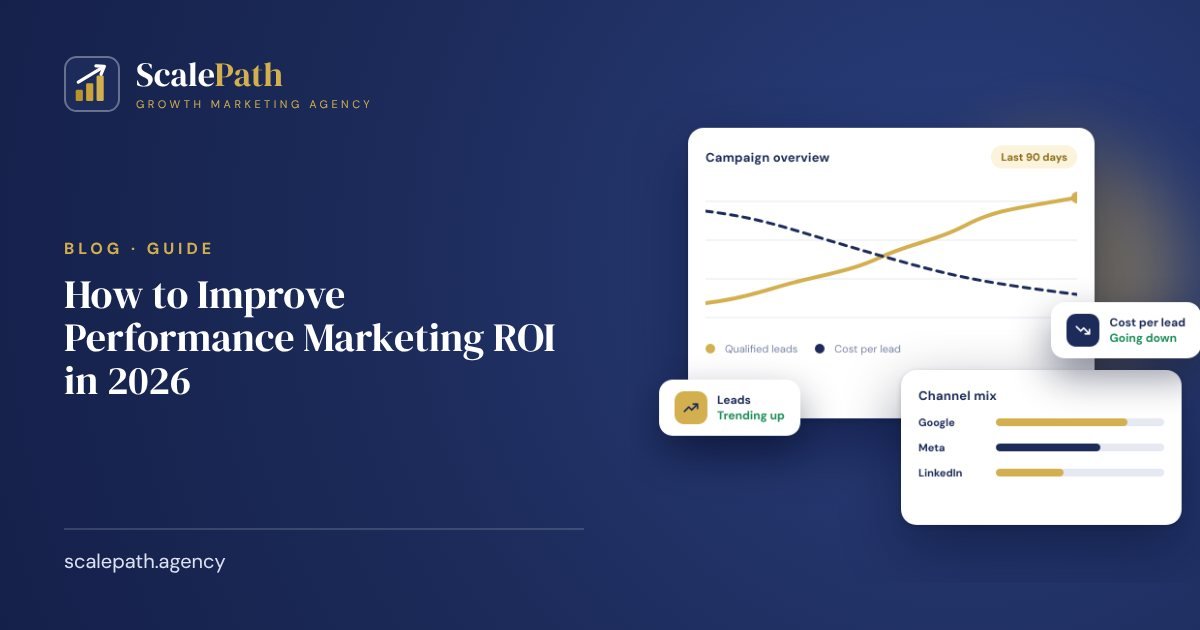
How to improve performance marketing ROI in short: track real conversions in a CRM, pick the bid strategy that matches your data volume, focus budget on your best audiences, feed first-party data back into the platform, and review creative weekly. Every other tactic builds on these five. See ScalePath's performance marketing services →
What Is Performance Marketing?
Performance marketing refers to digital advertising where you pay based on measurable outcomes — clicks, leads, purchases, installs, or other defined actions. Unlike brand advertising (where you pay for impressions or reach), performance marketing connects every rupee or dollar spent to a specific result.
The primary performance marketing channels in 2026 are:
- Google Ads — Search, Shopping, Display, YouTube, Demand Gen
- Meta Ads — Facebook and Instagram, across all placements
- LinkedIn Ads — B2B demand generation and account-based marketing
- Programmatic Display — DV360, The Trade Desk, and direct publisher deals
- App campaigns — Google UAC, Meta App Install, and Apple Search Ads
Key Channels: Where Should Your Budget Go?
Google Ads
Google Search remains the highest-intent channel in most verticals. Users who are actively searching for your product or service are much closer to converting than someone passively scrolling a social feed. For B2C e-commerce and service businesses, Google Shopping and Performance Max campaigns are increasingly dominant. For B2B, Search campaigns with tight keyword sculpting and negative keyword management still outperform most alternatives.
In 2026, Google's AI-powered campaign types — particularly Demand Gen and Performance Max — have matured significantly. Used correctly with strong audience signals and creative assets, they can extend reach while maintaining efficiency. Used carelessly, they will drain budget without accountability.
Meta Ads
Meta's advertising platform remains unmatched for visual storytelling and top-of-funnel audience building. The algorithm has become extraordinarily good at finding converters when given enough data — which means your creative quality and landing page experience matter more than granular targeting in 2026. Broad audience campaigns with strong creative often outperform heavily segmented setups, particularly for consumer goods, fashion, beauty, and lifestyle brands.
LinkedIn Ads
LinkedIn is expensive — CPCs routinely run 5–10x higher than Google Search — but for B2B brands targeting specific job titles, industries, or company sizes, the quality of the audience is unmatched. LinkedIn works best as a demand generation channel feeding a longer sales funnel, not a direct response channel expecting instant lead conversion.
Bidding Strategies That Actually Work
Bidding strategy selection is one of the most consequential decisions in any campaign. The three most important smart bidding strategies to understand are:
Target ROAS (tROAS)
Target ROAS instructs Google or Meta to optimise bids to achieve a specific return on ad spend. For example, a tROAS of 400% means you want £4 in revenue for every £1 spent. This strategy works best when you have clean, consistent conversion value data flowing into the platform — typically requiring 50+ conversions per campaign per month for reliable performance. Setting tROAS too high starves campaigns of traffic; setting it too low inflates spend without profitability.
Target CPA (tCPA)
Target CPA optimises bids to acquire conversions at a specific cost. This is the right choice when all conversions have approximately equal value — a lead form submission, for instance. Like tROAS, it requires sufficient conversion volume to work well. In the early stages of a campaign, Maximise Conversions (without a target) is often the better approach until the algorithm has enough data.
Maximise Conversions
The simplest smart bidding strategy — spend the entire budget, get as many conversions as possible. Use this during the learning phase or when you have a fixed daily budget and simply want volume. Once you have volume and reliable data, transition to tCPA or tROAS for efficiency.
Key insight: Smart bidding strategies are only as good as the conversion data you feed them. If your conversion tracking is broken, delayed, or capturing the wrong events, every bid decision the algorithm makes will be wrong. Fix tracking before optimising bids.
Audience Segmentation in 2026
Audience segmentation has fundamentally shifted. Third-party cookie deprecation, iOS privacy changes, and tightening data regulations mean that old-school audience targeting (retargeting everyone who visited any page, layering dozens of interest segments) is less effective than it once was.
In 2026, the most powerful audience strategies are:
- First-party data activation — uploading your CRM contacts, customers, and newsletter subscribers as custom audiences and lookalikes
- Intent signals — targeting search intent on Google, and engagement signals (video views, page interactions) on Meta
- Contextual targeting — appearing alongside relevant content regardless of user identity
- Predictive audiences — using platform ML to identify users likely to convert based on behavioural signals
The Importance of First-Party Data
First-party data — information you collect directly from your customers with their consent — has become the most valuable asset in performance marketing. This includes:
- Email addresses and phone numbers from CRM systems
- Purchase history and lifetime value data
- On-site behavioural data via server-side tagging
- App event data and in-app behaviour
Brands that invest in building and activating first-party data will have a structural advantage over competitors who rely on platform-owned audiences. This means implementing robust data collection practices, using Google's Enhanced Conversions and Meta's Conversions API, and building a CRM strategy that feeds clean data into your advertising platforms.
Attribution Models: Data-Driven vs Last-Click
Attribution is how credit for a conversion is assigned across the customer journey. Get it wrong and you will over-invest in last-touch channels (typically branded search or direct) while under-investing in the channels that actually drove awareness and intent.
Last-click attribution assigns 100% of conversion credit to the last ad click before purchase. It is simple to understand but systematically devalues upper-funnel channels — display, video, and social — that initiated the customer journey.
Data-driven attribution (now the Google Ads default) uses machine learning to distribute credit across all touchpoints based on their actual contribution to conversion. It is more accurate but requires sufficient conversion volume to be reliable. For accounts with fewer than 300 conversions per month, a position-based or time-decay model may be more appropriate.
The practical implication: run your reporting in multiple attribution windows and models. A channel that looks poor on last-click may be delivering significant value when viewed through a data-driven or view-through lens.
Creative Testing Frameworks
Creative — the ad itself — is now the primary lever for performance improvement on Meta and increasingly on Google. Platform targeting has converged; the algorithm finds the audience. Your job is to give it creative assets that resonate.
A robust creative testing framework includes:
- Hypothesis-driven testing — test one variable at a time (hook, offer, format, visual) with a clear hypothesis
- Sufficient sample sizes — do not call a test winner until you have statistical significance (typically 100+ conversions per variant)
- Regular creative refresh — most ad creative fatigues within 2–4 weeks; build a production pipeline
- Winning creative scaling — when a creative wins, move budget aggressively before fatigue sets in
- Format diversity — test static images, single-image, carousel, video (15s, 30s, 60s), Reels, and Stories
Reporting, OKRs, and Meaningful Metrics
Vanity metrics — impressions, clicks, CTR — are not performance. ROI metrics are: cost per acquisition (CPA), return on ad spend (ROAS), customer lifetime value (LTV), and contribution margin after ad spend. Build dashboards that surface these metrics at the campaign, ad group, and creative level.
Connect your performance marketing OKRs to business outcomes:
- Revenue contribution from paid channels
- Blended CAC (customer acquisition cost) versus LTV ratio
- New customer revenue percentage versus returning customer revenue
- Market share by keyword in competitive verticals
Common Mistakes to Avoid
After auditing hundreds of accounts, these are the mistakes that consistently destroy performance marketing ROI:
- Broken conversion tracking — the single biggest mistake. Audit your tracking before spending a penny.
- Too many campaigns, too little data — splitting budget across dozens of campaigns starves each one of the conversions needed for smart bidding to work.
- Ignoring landing page quality — a 3% conversion rate on a landing page means 97% of your paid traffic is wasted. CRO is as important as media buying.
- Set-and-forget campaigns — performance marketing requires weekly (often daily) attention: bid adjustments, negative keyword expansion, creative refreshes, and audience optimisation.
- Misaligned attribution — reporting in last-click while making budget decisions based on last-click leads to systematically over-investing in bottom-funnel and under-investing in growth.
- No control over brand terms — failing to bid on your own brand terms or monitor competitor conquesting can leak significant revenue.
Ready to Improve Your Performance Marketing ROI?
ScalePath manages multi-market performance campaigns across Google, Meta, and LinkedIn. Get a free account audit and see exactly where your budget is being wasted — and where the growth opportunities are.
Explore Performance Marketing →