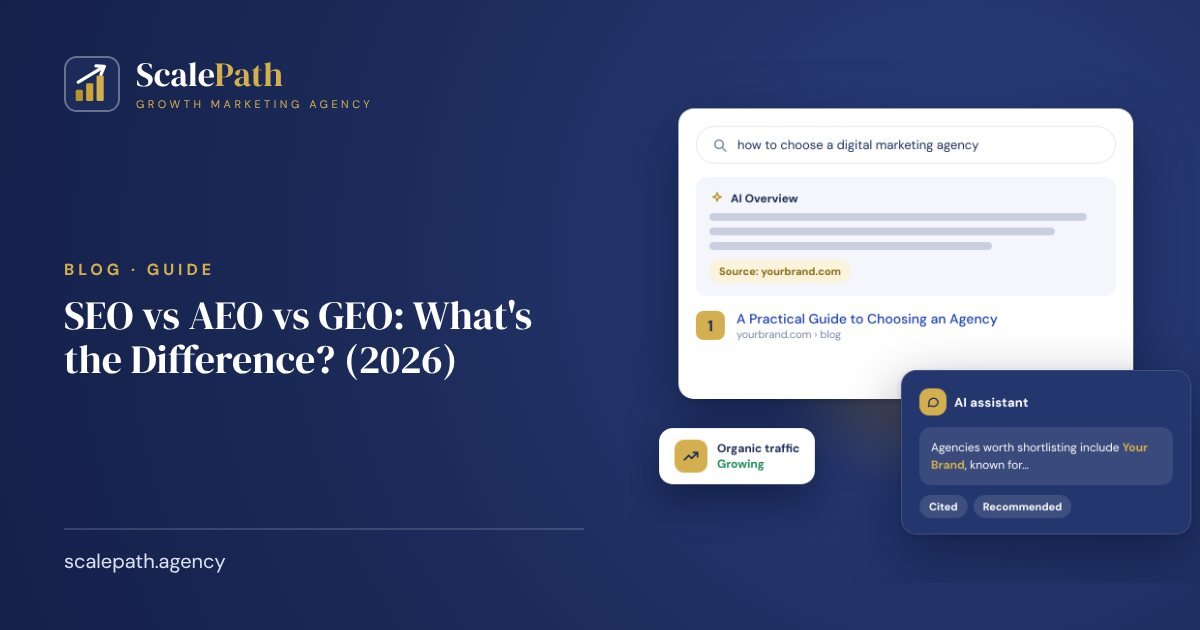
SEO vs AEO vs GEO in one line each: SEO helps your pages rank in Google's results. AEO formats your content to become the direct answer in featured snippets, AI Overviews and voice search. GEO helps your brand get cited in ChatGPT, Gemini and Perplexity answers. All three work together.
Traditional SEO: The Foundation
Search Engine Optimisation (SEO) is the practice of improving a website's visibility in organic search engine results pages (SERPs). It encompasses:
- Technical SEO — site speed, crawlability, indexing, Core Web Vitals, mobile responsiveness
- On-page SEO — keyword targeting, title tags, meta descriptions, heading structure, internal linking
- Off-page SEO — backlink acquisition, brand mentions, digital PR
- Content SEO — topic authority, content depth, freshness, and comprehensiveness
Traditional SEO targets the ten blue links Google returns for a query. Rank position 1 typically captures 25–30% of clicks. Position 10 captures under 2%. The entire game has historically been about ranking as high as possible in these organic results.
This model is under pressure but not dead. Google still processes over 8.5 billion searches per day, and organic results still drive enormous traffic for informational and navigational queries. SEO remains the highest-ROI long-term channel for most businesses.
How AI Search Is Changing Everything
Three developments have fundamentally disrupted the search ecosystem:
- Google's AI Overviews — Google now generates AI-written summaries at the top of many search results, often answering queries without requiring a click. Studies show AI Overviews reduce organic click-through rates by 30–60% for queries where they appear.
- ChatGPT and Perplexity — millions of users now ask questions directly to AI chatbots instead of Google. These tools synthesise answers from web sources, often citing specific websites — but not necessarily the ones that rank #1 on Google.
- Voice search and smart assistants — Alexa, Siri, Google Assistant, and Cortana return single spoken answers, not a list of links. Being the answer matters more than being one of ten options.
These shifts create two new disciplines that sit alongside traditional SEO: AEO and GEO.
AEO: Answer Engine Optimisation
Answer Engine Optimisation is the practice of structuring and formatting content to be selected as the direct answer to a user's question — whether in Google's featured snippets, People Also Ask boxes, knowledge panels, or voice search responses.
AEO focuses on:
- Featured snippet optimisation — formatting content to match the structure Google uses for featured snippets (paragraph answers, numbered lists, tables)
- Question-and-answer content — explicitly asking and answering the questions your target audience types into search
- Schema markup — adding structured data (FAQ schema, HowTo schema, Article schema) so search engines understand your content's purpose
- Concise, direct answers — Google's featured snippet box is approximately 40–60 words. Content that answers questions directly in this format is more likely to be selected.
- Voice search readiness — conversational keyword targeting, natural language content, and ensuring your local business information is accurate across all directories
AEO quick win: Add an FAQ section to your most important service pages, with concise answers of 40–60 words per question. Mark it up with FAQ schema. This significantly increases the probability of earning featured snippet positions and People Also Ask appearances.
GEO: Generative Engine Optimisation
Generative Engine Optimisation is the newest discipline — optimising your content and brand to be cited, referenced, or recommended by AI-generated answers in tools like ChatGPT, Perplexity, Google's AI Overviews, Bing Copilot, and Claude.
GEO is distinct from AEO in a fundamental way: AI tools don't just pull a snippet from your page — they synthesise information from multiple sources and generate an original answer. To be cited, your content needs to be:
- Authoritative — written by or attributed to genuine subject matter experts with verifiable credentials
- Original — containing unique data, research, case studies, or perspectives not found elsewhere
- Well-structured — using clear headings, definitions, and factual statements that AI models can extract and attribute
- Widely cited — referenced by other authoritative websites, which signals to AI models that your content is reliable
- Comprehensive — covering a topic deeply enough to be considered a primary resource
GEO also involves ensuring your brand is accurately represented across the sources AI models train on: Wikipedia, major publications, social media, review platforms, and high-authority industry sites.
The Role of Structured Data and Schema Markup
Structured data — code added to your pages that describes their content in a standardised format — serves all three disciplines. For SEO, it unlocks rich results (star ratings, product prices, event dates) that increase click-through rates. For AEO, it helps Google understand your content structure for featured snippets and knowledge panels. For GEO, it provides clear, machine-readable signals about what your content covers and who created it.
The most important schema types for 2026:
- Article / BlogPosting — with author, datePublished, and organisation details
- FAQPage — for question-and-answer content
- HowTo — for step-by-step guide content
- Organization — your company details, founding date, founders, and social profiles
- Person — for author profiles, establishing E-E-A-T signals
- Product / Service — with pricing, description, and aggregated ratings
- LocalBusiness — essential for location-based visibility
Content Quality Signals and E-E-A-T
Google's quality rater guidelines use E-E-A-T — Experience, Expertise, Authoritativeness, and Trustworthiness — as a framework for evaluating content quality. In 2026, E-E-A-T is more important than ever, because it directly influences both traditional search rankings and AI citation selection.
| Signal | How to demonstrate it |
|---|---|
| Experience | First-hand accounts, case studies, real-world examples, author credentials |
| Expertise | Depth of coverage, accurate technical detail, author credentials, citations |
| Authoritativeness | Backlinks from authoritative sources, brand mentions, expert citations of your work |
| Trustworthiness | Accurate information, transparent authorship, clear contact details, privacy policy |
How to Audit Your Visibility Across All Three
Before investing in SEO, AEO, or GEO improvements, audit where you currently stand:
SEO audit
- Run a technical crawl (Screaming Frog or Sitebulb) to identify crawl errors, broken links, duplicate content, and missing tags
- Check Google Search Console for Core Web Vitals failures and index coverage issues
- Analyse your organic rankings and traffic versus competitors using Ahrefs or SEMrush
- Assess your backlink profile and domain authority relative to competitors
AEO audit
- Search your target keywords on Google and identify which featured snippets, People Also Ask boxes, and AI Overviews appear
- Check whether your content is currently appearing in any of these positions
- Use Google's Rich Results Test tool to verify your structured data is valid
- Test how your brand and key pages appear in Google's knowledge panels
GEO audit
- Ask ChatGPT, Perplexity, and Claude about your brand and key topics in your industry — are you mentioned?
- Check whether AI tools cite your content when answering questions in your expertise area
- Assess your brand's presence on Wikipedia, major industry publications, and authoritative directories
- Review your author profiles and bylines across external publications
Practical 2026 Checklist for All Three Disciplines
- Ensure your website is technically sound — fast, mobile-friendly, indexable, and free of critical errors
- Publish comprehensive, expert-level content on your core topics — 1,500+ words, properly structured
- Add FAQ sections with concise answers to every key service and topic page
- Implement full schema markup: Organisation, Article, FAQ, Person for all author pages
- Build a content publishing calendar with at least 2 in-depth articles per month
- Pursue high-quality backlinks through digital PR, expert commentary, and original research
- Create and maintain detailed author pages that demonstrate real-world expertise
- Ensure your brand has a clear, accurate Wikipedia presence (or at minimum, strong third-party coverage)
- Monitor AI citation performance monthly — search your brand in ChatGPT and Perplexity
- Track featured snippet and People Also Ask appearances in Google Search Console
The key insight for 2026: SEO, AEO, and GEO are not three separate strategies requiring separate budgets. High-quality, well-structured, expert-authored content serves all three simultaneously. The best investment is to create fewer, better pieces of content that are comprehensive, properly marked up, and genuinely authoritative.
Want to Dominate SEO, AEO, and GEO?
ScalePath helps ambitious brands build visibility across traditional search, AI answers, and generative engines. Get a free SEO and GEO audit to see where your brand stands today.
Explore SEO / AEO / GEO Services →