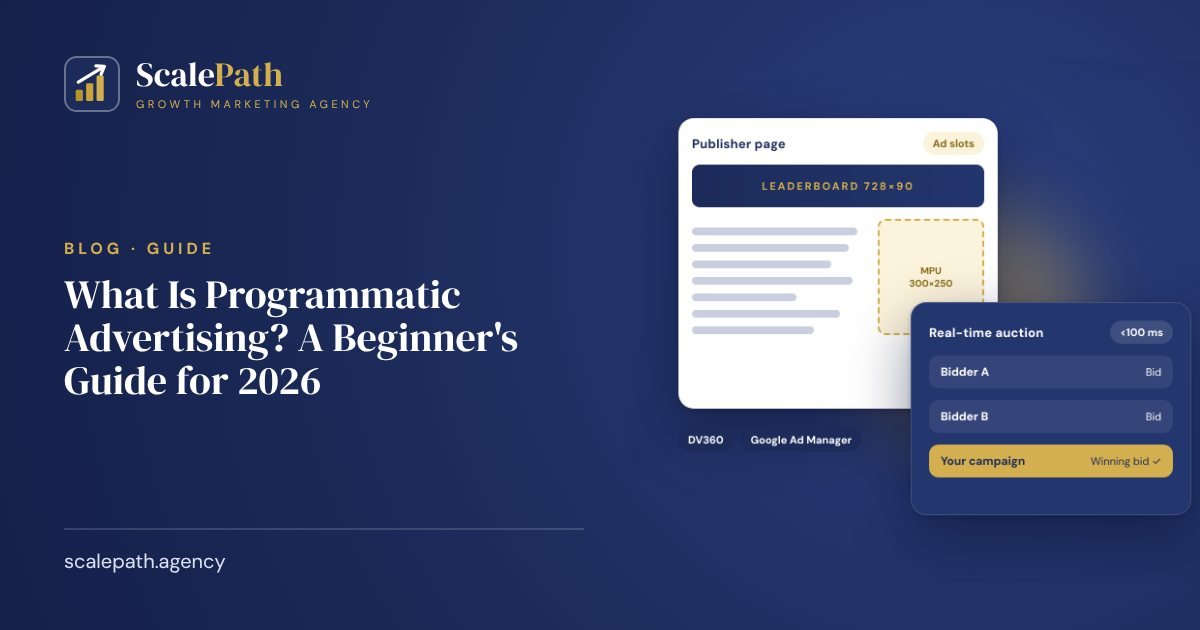
What is programmatic advertising? It is the automated buying and selling of digital ad space. Software bids for each ad impression in real time, so advertisers reach the right audience on thousands of websites at once, without contacting each publisher separately. ScalePath's programmatic advertising services →
What Is Programmatic Advertising?
Programmatic advertising is the automated buying and selling of digital ad inventory using software and data. Instead of negotiating placements directly with publishers (calling a newspaper to book an ad, for example), programmatic automates the entire process — finding available ad slots, evaluating their value, bidding on them, and serving the ad — all in milliseconds.
The result: advertisers can reach specific audiences across thousands of websites and apps, with real-time control over who sees their ads, where, at what price, and in what context — at a scale impossible through manual buying.
Programmatic covers display banners, video, native ads, connected TV (CTV), digital out-of-home (DOOH), audio, and in-app advertising. In 2026, programmatic has expanded well beyond web display to become the infrastructure for much of the digital media ecosystem.
Real-Time Bidding (RTB) Explained Simply
Real-time bidding is the auction mechanism that powers most programmatic transactions. Here is how it works in plain language:
- A user visits a webpage that has programmatic ad slots available
- The publisher's ad server sends an auction request to an exchange, sharing information about the user (anonymised) and the page context
- The ad exchange passes this request to multiple DSPs (advertiser-side platforms) simultaneously
- DSPs evaluate the opportunity — does this user match my target audience? What is this impression worth? — and submit a bid in real time
- The highest bid wins the auction, and the winning ad is served to the user
- The entire process takes approximately 100 milliseconds — faster than a blink
Most RTB auctions are now second-price auctions: the winner pays $0.01 more than the second-highest bid, not their full bid amount. This encourages honest bidding because you cannot gain by bidding lower than your true valuation.
DSP vs SSP vs DMP: The Key Players
DSP — Demand-Side Platform
A DSP is the technology advertisers use to buy programmatic inventory. It connects to multiple ad exchanges and SSPs, allowing you to manage bids, targeting, frequency capping, and reporting across thousands of publishers from a single interface. Examples: Google's DV360, The Trade Desk, Amazon DSP, Xandr.
SSP — Supply-Side Platform
An SSP is the publisher's technology for selling their ad inventory programmatically. It connects to multiple DSPs and exchanges to maximise competition and therefore revenue for each impression. Examples: Google Ad Manager (GAM), Magnite, PubMatic, OpenX.
DMP — Data Management Platform
A DMP is a centralised data platform that collects, organises, and activates audience data from multiple sources — your own first-party data, third-party data providers, and CRM systems. DMPs feed audience segments into DSPs for more precise targeting. Examples: Adobe Audience Manager, Oracle BlueKai, Salesforce DMP. Note: CDPs (Customer Data Platforms) have increasingly replaced DMPs for first-party data management.
DV360 and Google Ad Manager: The Google Ecosystem
Google's programmatic stack is the most widely used in the world and the most important to understand:
DV360 (Display & Video 360)
DV360 is Google's enterprise DSP. It gives advertisers access to Google's own inventory (YouTube, Gmail, Display Network) plus third-party exchanges, private marketplace deals, and premium publisher inventory. DV360 offers more sophisticated audience targeting, reporting, and campaign management capabilities than Google Ads, and is designed for agencies and enterprise advertisers managing significant programmatic budgets.
Key advantages of DV360:
- Access to YouTube TrueView and brand-safe inventory at scale
- Advanced audience modelling using Google's first-party data signals
- Deal ID management for private marketplace buys
- Cross-channel frequency management across display and video
- Integration with Campaign Manager 360 for unified attribution
Google Ad Manager (GAM)
GAM is the publisher-side platform (SSP) that works with DV360. As the world's most widely used ad server, GAM manages how publishers like news sites, sports portals, and content platforms fill their ad slots — balancing direct deals, preferred deals, and open auction programmatic revenue to maximise yield.
Audience Targeting Options in Programmatic
Programmatic's power comes from its targeting precision. The main targeting approaches are:
Contextual targeting
Placing ads alongside relevant content regardless of who the user is. A financial services brand advertising on a personal finance article. Contextual targeting does not rely on user identity data, making it fully privacy-compliant and immune to cookie deprecation. In 2026, contextual targeting has experienced a significant renaissance.
Behavioural targeting
Targeting users based on their browsing and purchase history. A user who recently visited multiple car-buying websites can be identified as an in-market auto buyer and targeted by car manufacturers. Behavioural targeting relies on third-party cookies or device IDs, which are increasingly restricted by browsers and platforms.
Lookalike and predictive audiences
Uploading your existing customer data and asking the DSP to find users who statistically resemble them. This leverages machine learning to identify high-propensity users who match your best customers' profile.
Retargeting
Re-engaging users who have previously visited your website or interacted with your app. First-party retargeting (using your own pixel data) remains effective; third-party cross-site retargeting is increasingly restricted.
Brand Safety and Viewability
Two critical quality metrics every programmatic advertiser must monitor:
Brand safety refers to ensuring your ads do not appear alongside harmful, controversial, or brand-damaging content. Programmatic's scale means without safeguards, you can inadvertently fund extremist content, piracy sites, or fake news. Solutions include IAS (Integral Ad Science) and DoubleVerify for third-party verification, pre-bid brand safety segments, and allow-lists that restrict your campaigns to approved publisher domains.
Viewability measures whether an ad was actually seen — was it on screen for long enough for a user to see it? Industry standard (per the IAB) is 50% of pixels in view for at least 1 second for display ads, and 50% in view for at least 2 seconds for video. A campaign with a low viewability rate (under 50%) is delivering many ads that users never have a chance to see. Optimise for viewable impressions, not raw impressions.
Programmatic vs Direct Buys
Not all display advertising is bought programmatically. Understanding when to use each approach:
- Open auction (RTB) — maximum reach, lowest CPMs, less control over exact placement. Best for scale and efficiency.
- Private Marketplace (PMP) — a curated RTB auction with selected publishers offering inventory at negotiated floor prices. Better brand safety and inventory quality than open auction.
- Preferred Deal — a fixed-price deal with a specific publisher for first-look access to inventory, without the auction dynamic.
- Programmatic Guaranteed (PG) — fixed price, guaranteed impression volume, specific targeting. Combines the automation of programmatic with the certainty of direct buying. Best for high-profile campaigns where inventory certainty matters.
- Direct IO (Insertion Order) — a traditional direct deal negotiated without programmatic pipes. Still relevant for sponsorships, roadblocks, and custom integrations that programmatic cannot support.
Header Bidding Explained
Header bidding is a technical innovation that fundamentally changed how publishers sell programmatic inventory. Before header bidding, publishers used a "waterfall" model: they offered impressions to DSPs in a pre-set priority order, and the first DSP to meet the floor price won — even if a lower-priority DSP would have bid more.
Header bidding changed this by allowing multiple DSPs to bid simultaneously, in parallel, before the publisher's ad server makes a decision. A small JavaScript tag in the page header runs auctions with multiple DSPs at the same time, collects all bids, and passes the highest to the ad server. The result: publishers earn significantly more revenue (typically 15–50% uplift), and advertisers get fairer access to premium inventory.
For advertisers, understanding header bidding matters because it affects bid strategies in DV360 and other DSPs, and because it explains why winning a single impression often involves competing against many buyers simultaneously.
How to Get Started with Programmatic
- Define your objective — brand awareness (CPM-based), consideration (video completion, engagement), or performance (CPA, ROAS). Your objective determines the right channels, formats, and measurement approach.
- Choose your DSP — for most businesses starting out, DV360 (through Google's partners) or The Trade Desk are the most comprehensive options. Smaller budgets may start with Google Display Network before moving to DV360.
- Set minimum budgets — programmatic requires sufficient scale to generate meaningful data and optimisation signals. A minimum of $5,000–$10,000 per month is typically needed to see reliable performance patterns.
- Implement brand safety controls — before going live, configure IAS or DoubleVerify brand safety segments, set category exclusions, and establish an allow-list of approved domains.
- Build your creative assets — programmatic display requires multiple creative sizes (300x250, 728x90, 160x600, 320x50, and responsive) plus video assets (15s and 30s). HTML5 animated creatives consistently outperform static.
- Set up measurement — implement conversion pixels, integrate with your attribution solution, and establish viewability and brand safety reporting before the campaign starts.
Common Mistakes and How to Avoid Them
- Ignoring brand safety — running without brand safety controls will result in ads appearing on inappropriate content. Always configure IAS or DoubleVerify before going live.
- Optimising for impressions, not outcomes — cheap CPMs are not a sign of success. Optimise for viewable CPMs, then for engagement or conversion metrics aligned to your objective.
- Too many small line items — fragmenting budgets across dozens of small targeting segments prevents the algorithm from accumulating enough data to optimise. Consolidate into fewer, larger line items.
- Neglecting frequency capping — without frequency caps, the same users see your ad dozens of times per day, wasting budget and damaging brand perception. A reasonable starting point is 3–5 impressions per user per day.
- Skipping the viewability audit — run a viewability audit in your first campaign flight. If viewability is below 50%, shift budget away from low-quality inventory immediately.
- Treating programmatic display as a direct response channel — display advertising builds awareness and consideration. Expect longer attribution windows and measure its contribution to overall conversion lift, not just last-click conversions.
Key takeaway: Programmatic advertising offers unmatched scale and targeting precision — but only when properly set up, monitored, and optimised. The technology is powerful, but it requires expertise and ongoing attention to deliver results rather than waste budget. Working with a specialist partner is often the most efficient path for brands new to programmatic.
Ready to Run Smarter Programmatic Campaigns?
ScalePath manages DV360, Google Ad Manager, and programmatic media buying for brands across UAE, UK, USA, and global markets. Get a free consultation and find out how programmatic can complement your existing performance marketing.
Explore Programmatic Services →